
Which American Fork Records Are Open
Open American Fork records are spread across three levels of government. The city keeps its own council, planning, permit, cemetery, licensing, and police material. Utah County holds land ownership, tax, marriage-license, election, and jail files. Courts and state agencies control case records, vital certificates, professional licenses, business registrations, corrections data, and older archival series. An online name result is often just an index. The signed document or certified copy may require a separate order.
| Record group | Official keeper | Web access | Other access |
|---|---|---|---|
| Deeds, liens, plats | Utah County Recorder | Free Land Records index and images | Recorder counter; plain or certified copy |
| Property, value, tax | Recorder, Assessor, Treasurer | Owner, address, serial, map, and tax searches | County counter or focused GRAMA request |
| City reports and files | American Fork department holding the file | No single historic index | City form, email, fax, mail, or counter |
| District and justice cases | Utah State Courts | Xchange; MyCourtCase for eligible parties | Free courthouse terminal or clerk request |
| Birth, death, marriage, divorce | Utah vital offices, County Clerk, courts, Archives | Age-open Archives indexes and images | Online, mail, or local health office order |
| Jail and corrections | Utah County Sheriff and Utah DOC | Current public locators | Agency request for releasable reports |
Public access does not expose every field. Utah withholds recent vital certificates from general browsing, restricts juvenile and adoption files, and protects medical, security, motor-vehicle, government-ID, and address-confidentiality data. A public deed or docket may still contain redactions. Voter information has its own access rules, described separately in the American Fork voter records resource.
American Fork Recorder Search Fields
The Utah County Land Records menu is the main property portal for American Fork. It separates searches by owner, street address, parcel serial number, subdivision, entry number, book and page, document party, instrument kind, legal location, mining records, and water rights. It also links appraisal, current and historic tax, delinquency, abstract, map, plat, and document-image tools. Web inspection and available images are free.
| Search option | Input | Useful detail |
|---|---|---|
| Property Name Search | Owner name | Surname alone works; the full form is LAST, FIRST MIDDLE |
| Address Search | Number, direction, street, type, city | Choose American Fork and test standard street forms |
| Serial Number Search | County parcel serial | Connects the parcel card, maps, taxes, and abstracts |
| Documents by Name | Recorded party name | Searches grantors and grantees, the parties transferring an interest |
| Entry Record Search | Entry number and year, or recording date | Date format is MM/DD/YYYY |
| Kind of Instrument | Code or description and optional date | WD means warranty deed; no date sorts newest first |
A typical document result gives entry number and year, recording date, instrument type, indexed names and roles, linked parcels, and image or abstract links. The deed image can add mailing addresses, the land description, signatures, notary data, and a return address. The Recorder records and supplies documents, but it does not perform a title search or interpret what an instrument means.
American Fork Record Books Since 1870
Utah County’s chronology explains why one search box cannot find every old American Fork name. Official Recorder books span 1870 to the present. The alphabetical party index was handwritten through January 1978, when computerized party indexing began. Abstracts were handwritten or typed from 1870 through September 1985, while online computerized abstracts begin in May 1980. Those ranges overlap because the county kept several finding systems at once.
Older scans reach beyond the official 1870 series. Land Record Book J covers 1864 to 1870, and images of earlier LDS Church conveyances extend to 1851. Deed books, grantor and grantee runs, lien indexes, mining records, plat books, typed abstracts, and REDI Books from 1976 to 1977 remain separate image groups. When a modern party query has no result, use the appropriate historic index and book rather than treating silence as proof that no instrument exists.
Note: The official interface gives no single universal start year for every online grantor and grantee search.
American Fork Parcel Fields Explained
A parcel card distinguishes the owner’s mailing address from the situs address, which is the physical site of the land. That split matters. An owner may receive tax mail outside American Fork even though the parcel sits in the city. The card can also show the serial number, subdivision, acreage, property type, value and tax history, improvements, photographs, owner history, recorded abstracts, and the latest linked document.
The county serial follows a book, page, and parcel pattern written as two digits, three digits, and four digits. Use that identifier to keep the same tract in view when a street label changes. The card’s taxing description is not a deed-ready legal description. A legal description identifies land in a recorded instrument; obtain it from the deed or recorded plat when exact boundary language is needed.
- Index
- A finding aid that points to a record; it is not always the full document.
- Image
- A scanned copy of the recorded page, which may show more than the index row.
- Certified copy
- A copy authenticated by the custodian for uses that require official proof.
- Custodian
- The government entity that maintains and responds for a record.
- Exemption
- A legal basis for withholding a record or specific fields from disclosure.
American Fork GIS Dates and Boundaries
The Utah County Parcel Map accepts a street address, common place, parcel serial, owner name, city, or public-land survey section. Its historic-date control refers to when parcel geometry entered the online property database. It is not the date a deed was recorded. The map is also a reference tool, not a survey.
A postal address that says American Fork does not by itself establish city jurisdiction. City limits can shift with annexation, while postal naming may remain familiar. Check the parcel and municipal boundary before sending a permit, planning, or police request. County land records still govern ownership, but the boundary tells whether American Fork or another municipality likely holds the city-created file.
Note: Search the map by owner or address, then use the serial number to keep county systems tied to the same parcel.
American Fork Court Records After Closure
The American Fork District Court counter closed on December 31, 2024, and its general-jurisdiction work moved to Fourth District Court in Provo. Older entries may still carry AFDST or AMC location codes. Those labels are historic routing signs, not proof that a local district counter remains open. The North Utah County Juvenile Court remains in American Fork, but juvenile legal and social files are restricted.
Broader name searches run through Utah Courts Xchange. It can search district court, justice court, or both by party name, optional birth date, location, case type, and date range. Online use has registration, query, document, or subscription charges. Free Xchange terminals at many district courts and the Utah State Law Library provide the main no-subscription fallback. A person eligible to view their own case can use MyCourtCase at no charge. Actual file copies come from the clerk through the court-record request process.
A docket may list the case number, filing date, parties, attorneys, role codes, events, minutes, and balances. It does not prove an allegation. Adoption and expunged cases are sealed, while some family, medical, victim, identity, child, and security information is private or protected. A public order may coexist with private pleadings in the same case.
American Fork Vital Record Boundaries
Recent certificates are identity records, not open name directories. Utah opens births after 100 years, deaths after 50 years, and marriages or divorces after 75 years under Utah Code Title 26B, Chapter 8. Before those points, the subject, a qualified relative, or a legal representative generally must show identity, relationship, or legal need. Orders can be placed online, by mail, or through a participating local health department.
The Utah vital-record ordering service shows the current channels and eligibility rules.
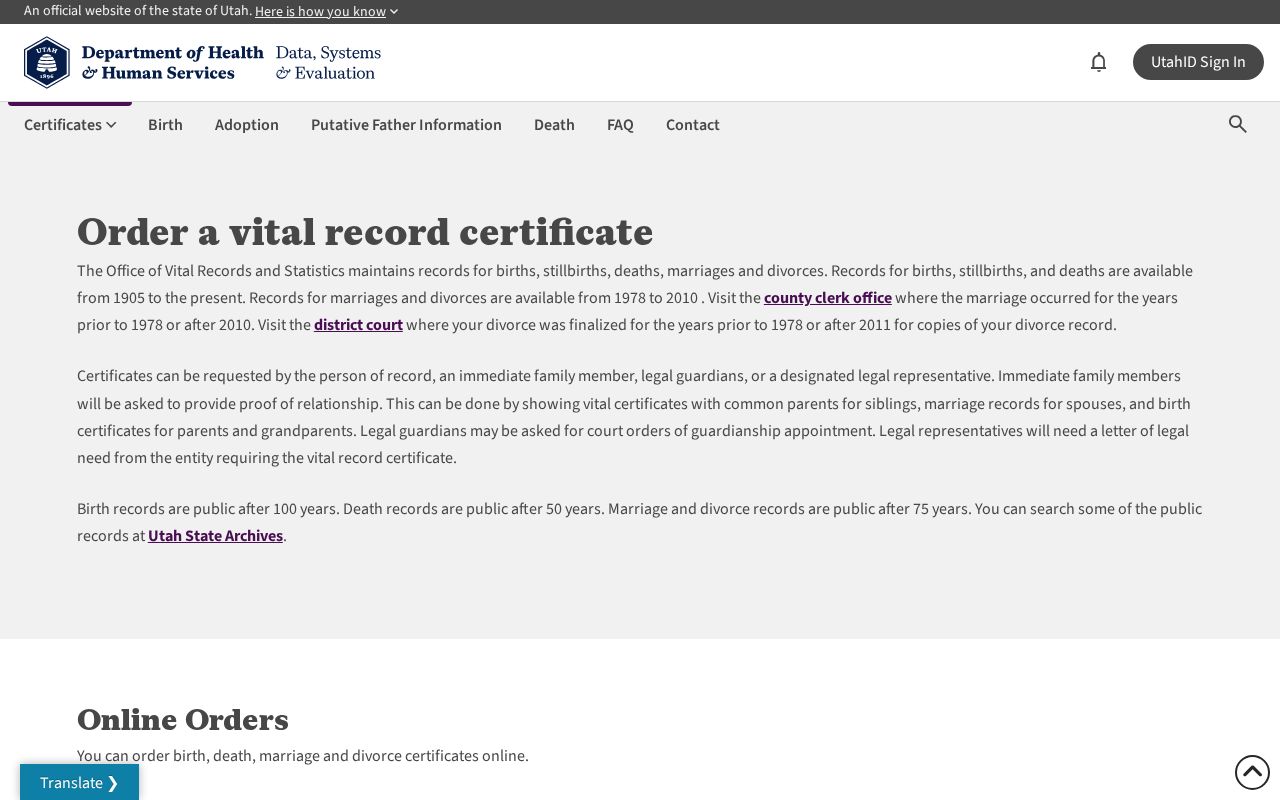
The ordering screen is the route for eligible recent certificates, while age-open records belong in the Archives search path. Current initial fees are $25 for birth, marriage, or divorce abstracts and $35 for a death certificate. A complete application, valid ID, and any needed proof of relationship must accompany the order. The current fee page controls if an older PDF displays a prior amount.
For historic research, the Utah State Archives birth index offers name searching and year-based browsing.
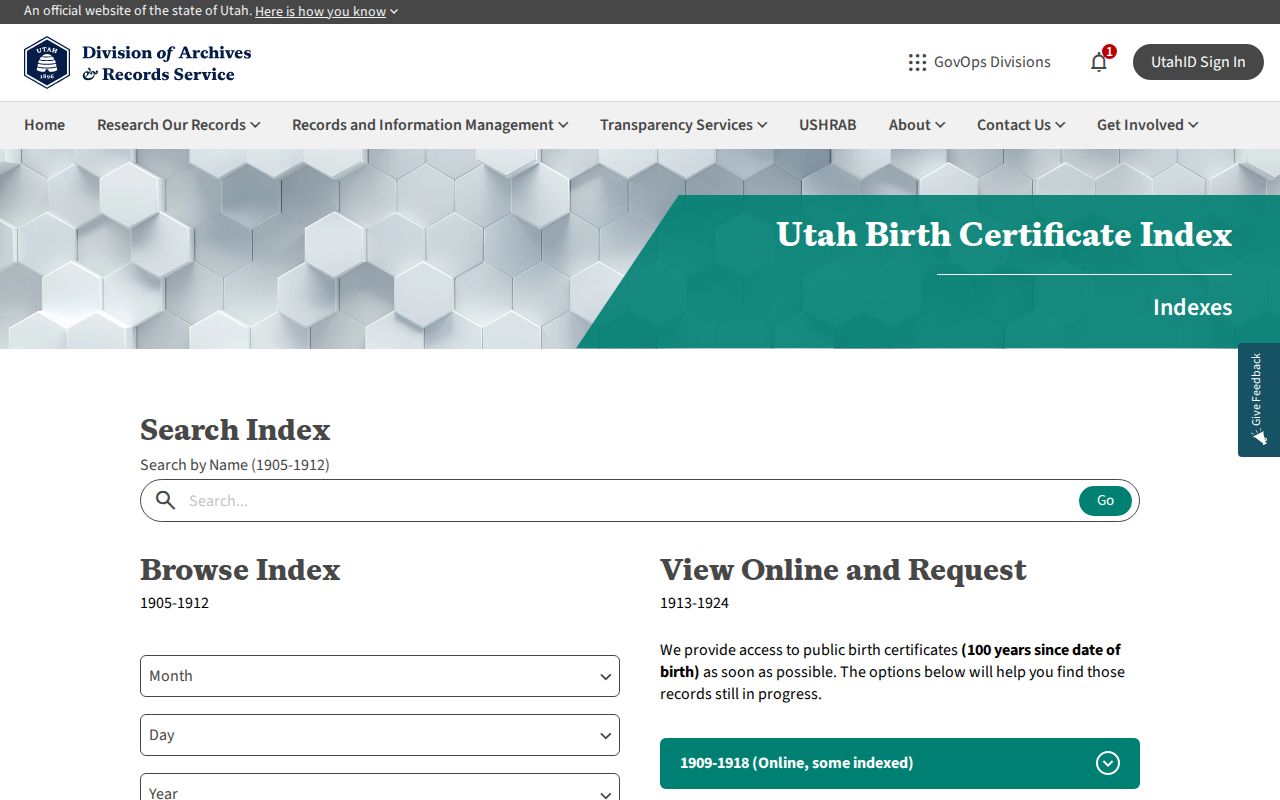
The Archives screen leads to public index entries and digitized images for qualifying years. Utah County birth and death registers from 1898 to 1905 and marriage-license applications are among the transferred county series. The statewide birth tools include a 1905 to 1912 name index and several image, Soundex, browse, and copy-request ranges.
American Fork Public Records Custodians
The key counters are not all in American Fork. Provo is the Utah County seat, so the Recorder and current Fourth District Court counter are there. City Hall remains the first stop for American Fork municipal material. Call or email the receiving department before a visit when the record type is uncertain.
Utah County Recorder
100 E Center St., Room 1300
Provo, UT 84606
801-851-8179
Monday through Friday, 8:30 a.m. to 5 p.m.
Fourth District Court
137 N Freedom Blvd.
Provo, UT 84604
801-429-1000
Clerk requests and public Xchange terminal
City Hall lists general hours of Monday through Thursday, 7 a.m. to 6 p.m., and Friday from 8 a.m. to noon and 1 to 4 p.m. The city form must go to the department that holds the file. A city request cannot compel Utah County, the courts, or a state agency to produce its records.
American Fork Police and Custody Records
Police reports, jail status, court filings, and corrections records answer different questions. American Fork Police accepts written records requests at City Hall or by email with identification and a detailed description. Reports cost $5 for city or Cedar Hills residents and $20 for nonresidents. An open investigation may remain withheld until closure or supervisor review. Court dockets must still be requested from the judiciary.
The Utah County Sheriff inmate search covers current custody and recent arrest data, subject to a reported delay. It searches by name, arrest date, or current-inmate status. The Utah Department of Corrections locator covers people under current state incarceration, probation, or parole. Registry results carry a strict warning against threats, stalking, or harassment. A booking code or charge is not a final court disposition, so verify the filed case with the court.
American Fork Record Copies and Alerts
Recorder web images are free, but an office copy costs $1 per page. Certification adds $5. An ownership plat costs $2, an official subdivision plat costs $4, and a screen print costs $0.50. A certified copy is useful when the recipient demands proof from the custodian. For research, the free image may be enough to inspect names, dates, roles, and the recorded land description.
The Utah County Property Watch service lets a user find a parcel by serial number or by a person or business name.
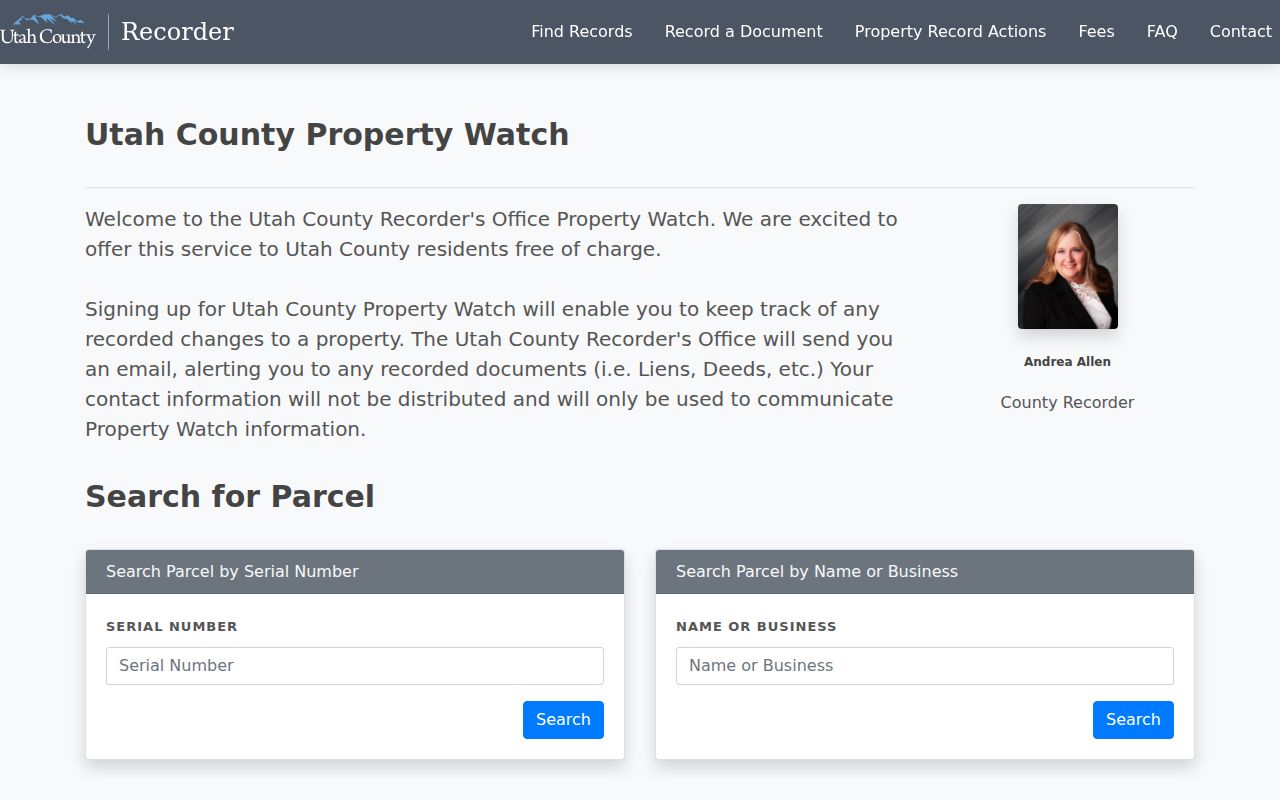
The captured service shows the search and subscription route used to connect a parcel serial with an email address. Alerts cover fully processed changes such as deeds and liens. They are free, do not distribute contact information, and are not guaranteed to prevent fraud. Treat an alert as a prompt to inspect the new instrument, not as title insurance or proof that a filing is valid.
Utah GRAMA Rules for American Fork
The Government Records Access and Management Act, or GRAMA, classifies government files as public, private, controlled, protected, or otherwise restricted. A written request goes to the entity that maintains the file. It should give the requester’s name, mailing address, daytime phone when available, and a specific description of the existing records sought.
The ordinary response period is up to ten business days. A supported request that primarily benefits the public may qualify for a five-business-day response. The city can charge reasonable actual costs, including staff time after the first 15 minutes. Under the state rule, inspection and the first 15 minutes generally cannot be charged, subject to repeat-request limits. Prepayment may be required when estimated fees exceed $50 or an older bill remains unpaid.
A denial must identify the withheld record or portion, cite its legal basis, and explain appeal rights. The first appeal ordinarily goes to the entity’s chief administrative officer. Further review may involve the Government Records Office, State Records Committee, or district court. GRAMA requires access to existing records; it does not force staff to answer a question or create a new report.
Request American Fork Public Records
The American Fork city form asks for the department, requester name, address, phone, email, a detailed description, and a choice between inspection and copies. It also includes a cost ceiling, an optional waiver request, requester-status choices, and an expedited-response box that needs proof of public benefit. Utah’s Open Records Portal can route requests to participating state entities. Email, fax, mail, and in-person delivery remain valid channels when the proper custodian accepts them.
- Identify the entity that created or now retains the record. Separate city, county, court, and state files.
- Inspect its free index first. Save names, dates, parcel serials, case numbers, entry numbers, or other identifiers.
- Describe the record type, date range, names or spelling variants, address, and preferred electronic format.
- Choose inspection or copies, set a cost ceiling, and submit by the office’s form, portal, email, fax, mail, or counter.
- Calendar the response deadline. If fees arise, ask for an itemized estimate and consider the statutory waiver grounds.
- If access is denied, request the cited exemption and appeal instructions, then file the first appeal with the chief administrative officer.
Lawful personal use. Open access does not authorize stalking, threats, harassment, or attempts to defeat a protected address. Stop at a privacy control and use records only for lawful purposes.
A narrow request usually works better than “all records” about a person. It lets staff identify a record series, estimate a fee, and separate releasable pages from protected fields. If the first office does not hold the material, ask which entity created or retains it before resubmitting.